
Artificial intelligence needs infrastructure that thinks ahead.
The EU is currently funding the construction of large, centralized AI data centers. The idea sounds powerful — but it solves a structural problem with even more structure.
Polarise GigaGrid™ relies on a decentralized network of intelligent AI factories — distributed across Germany and Europe, connected into a shared grid, scalable node by node.
Sovereign. Resilient. Faster to deliver.
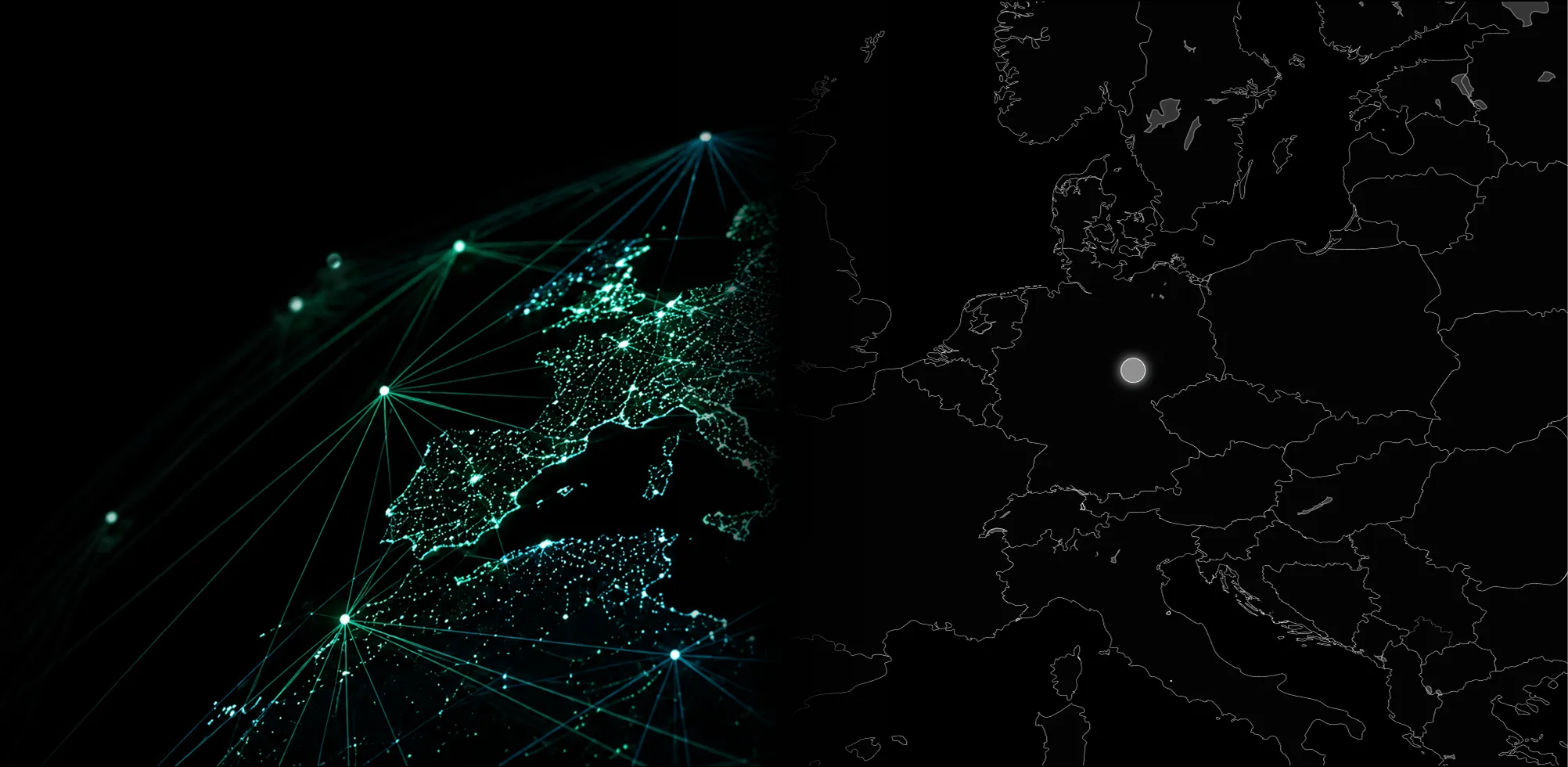
EU-funded AI factory plans target a few centralized sites with compute in the triple-digit megawatt range. That is understandable — but from an infrastructure and economic perspective it comes with significant risks:
A campus for several hundred megawatts needs vast plots in industrial zones. Such land is already scarce, expensive, and contested in Germany today.
Concentrating several hundred megawatts at a single node overwhelms local grids. Grid connection, state allocation, and permits become a lengthy bottleneck instead of an enabler.
The economics of such a large single facility depend heavily on a few major customers. If an anchor tenant drops out or demand is delayed, the business case breaks.
Using or dissipating several hundred megawatts of waste heat at one location is a technical and infrastructure challenge most regions are not prepared for.
A single site is a single point of failure. Outages, physical attacks, or critical network disruptions immediately affect the entire system.
In short: the pure gigafactory approach bets on scale where networking is needed.
Polarise GigaGrid treats AI infrastructure as a network. Instead of one gigafactory, a federation of many smaller, highly optimized AI factories emerges — typically in the low two-digit megawatt range.
Sites are intelligently connected. Workloads can shift between nodes based on availability, power price, or utilization. We call this architecture SAIGN — Smart AI Grid Network.
AI factories at multiple sites in Germany and Europe that can operate independently of one another.
Grid management distributes compute loads dynamically across the network.
Existing industrial sites or data center locations can be upgraded — instead of waiting years for greenfield development.
Capacity grows with each new site, not only when a single massive project is completed.
The result: a resilient overall system that goes live faster, spreads risk more evenly, and adapts to real market needs.

Capacity spread across many locations
Everything concentrated at one site
Scaling through more connected nodes
Scaling through ever larger blocks
Broader customer base
High dependence on large customers
Waste heat decentralized and usable regionally
Waste heat concentrated in one place
No single point of failure — outages, attacks, and network issues stay localized
Single point of failure — one incident can affect the entire system
Load distributed across existing grid structures
Grid bottlenecks at one point
AI infrastructure is strategic infrastructure. That is why Polarise operates all GigaGrid sites exclusively within the European Union.
Data processing under European data protection law.
Operations under European jurisdiction.
No access for US authorities based on extraterritorial data requests.
Highest security and availability standards for critical workloads.
In Polarise’s view, true sovereignty is not created by a single mega-site, but by a resilient, distributed network under European jurisdiction.
Polarise originated the GigaGrid concept and is already implementing it. That sets our approach apart from pure planning exercises or centralized infrastructure models currently under discussion.
We developed the decentralized AI grid network and are actively driving its rollout.
Polarise already operates AI-ready infrastructure in Germany and Europe.
A new AI Factory in the Augsburg region (Amberg/Unterallgäu) is planned with 30 MW initial capacity, scalable to 120 MW.
Infrastructure for regulated sectors such as banking and financial services that need sovereign, compliant environments.
While others rely on monolithic campus sites or pure cloud resale models, Polarise offers specialized, pragmatic infrastructure for AI workloads — direct, controllable, and scalable.
Decision-makers at federal, state, and EU level seeking a more resilient, faster-to-deploy alternative to the pure gigafactory approach.
Companies that want to run AI training and inference under their own jurisdiction, close to their sites.
Institutions that must meet regulatory requirements (BaFin, DORA) with sovereign infrastructure.
Partners for expanding further nodes in the grid.
Centralized AI factories are one path. But not the only one.
GigaGrid offers a verifiable alternative: faster to deliver, economically viable, structurally safer, and politically sovereign.
Polarise is building this network. Now.